U.S. Military Envisages Six Layers of Air Defense Networks in Response to the Threat of UAVs!
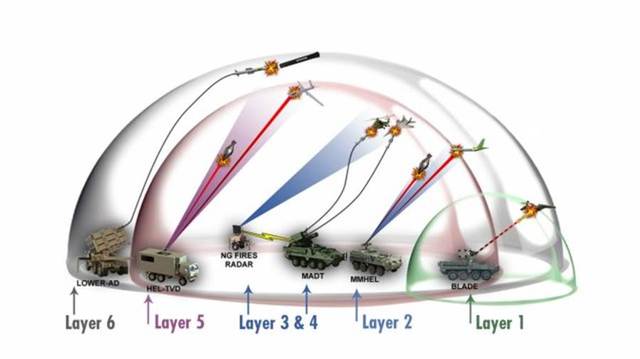
The U.S. Army has envisaged a future six-tier air defense network, hoping to deal with low-cost, unpredictable and difficult-to-detect targets such as UAVs, rockets and home-made rockets in a low-cost, multi-volume manner.
The lowest layer of US air defense consists of light weapon stations and transducers of motor off-road vehicles, which can shoot down invading UAVs. According to the U.S. Army, on the envisaged first level is the lowest altitude high-mobility protection system, known as BLADE, short for Ballistic Low Altitude Drone Engagement. The sensor is a low-altitude phased array radar and an infrared reconnaissance device used in conjunction with a common remote control weapon station (CROWS). It is quite light and can be installed on mobile off-road vehicles like Hummers, which will be on display later this year.
The second layer is a multi-mission high energy Laser (MMHEL) with solid-state laser gun as its core. The biggest advantage of the laser is that it can destroy incoming missiles and drones at a lower cost without ammunition limitation. The U.S. Army Research Laboratory has developed mature optical fiber laser technology, which reduces size, weight and complexity. MMHEL currently achieves technical level 7 and will be implemented with various targets in FY2021. It can be installed on Stryker 8-wheeled armored vehicles.
The third and fourth layers are mobile air defense technology (MADT) and the next generation of fire control radar. A 7.62 cm machine gun and four Stinger light air defense missiles are installed with MADT. Testing is planned for 2021.
Layer 5 defensive laser guns differ from Layer 2 in that they are more powerful and require larger vehicles. Layer 5 is also a laser weapon, called High Energy Laser Tactical Vehicle Demonstrator (HEL-TVD), which will install a 100,000-watt laser system on medium-sized tactical vehicles. It is planned to reach technical level 4 (or higher) by 2028.
Layer 6 is Low-cost Extended-Range Air Defense (LOWER-AD), a planned missile interception system that is smaller and less costly than other large systems and is expected to be deployed in large quantities. With more missile stocks than the Patriot series, it looks like an Israeli iron dome, but has a longer range and is of the highest level of defense. As subsonic cruise missiles and attack UAVs are becoming more and more lethal, and advanced Patriot missiles are under greater pressure threat, it requires less costly, large numbers of anti-aircraft missiles to fight. Flight tests will be conducted in FY2021 to prove that the technology has reached technical level 6.